Truth or Tall Tale? Unraveling the Pirate Legends of the Outer Banks
Blackbeard's Ghost & Buried Gold: What Really Happened When Pirates Ruled the Outer Banks?
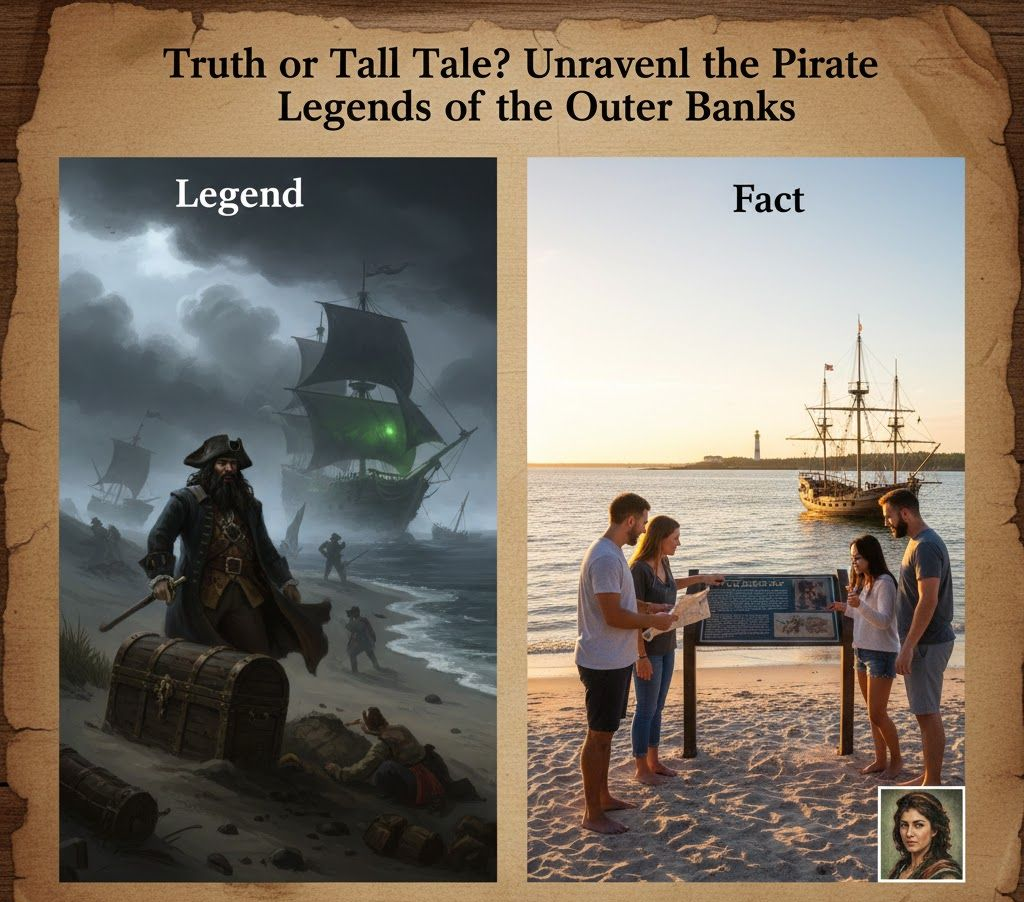
Ahoy, mateys! You know us "Four Fine Friends"—we love a good story, especially when it involves salty air, historical intrigue, and maybe a little bit of swashbuckling. And if you’ve ever spent time on North Carolina’s Outer Banks, you know that the tales of pirates are as abundant as seashells on the shore. From Blackbeard's buried treasure to ghostly galleons, the legends run deep. But how much of it is true, and how much is just good ol' fashioned pirate lore? Let's hoist the main sail and dive into the fascinating world where myth meets reality on our favorite sandbar!
The King of the Pirates: Blackbeard and His Reign of Terror (and Retreat!)
The Legend: Edward Teach, better known as Blackbeard, is probably the most famous pirate associated with the Outer Banks. The stories paint him as a terrifying figure with lit fuses in his beard, commanding a fearsome crew, and burying vast treasures all along the coast, especially near Ocracoke Island. Many still believe his gold lies hidden beneath the dunes, waiting to be discovered!
The Facts: While the fuses in his beard are likely a dramatic embellishment, Blackbeard was indeed a truly formidable pirate. He terrorized the Atlantic in the early 18th century, and the Outer Banks—particularly the shallow, protected waters of Ocracoke Inlet—became his favorite hideout and strategic base. It allowed him to prey on merchant ships navigating the busy colonial trade routes. He even blockaded Charleston, South Carolina, for a time! His end was famously violent: in November 1718, Lieutenant Robert Maynard of the Royal Navy cornered Blackbeard in Ocracoke Inlet, leading to a brutal hand-to-hand battle where Blackbeard was killed.
The Reality Check: While Blackbeard was certainly a presence, he wasn't really a "treasure burying" kind of pirate. Most pirates operated on a "spend it quick" philosophy, enjoying their spoils in port. The idea of vast buried treasure is mostly a romanticized notion that emerged much later, fueled by authors like Robert Louis Stevenson. However, his presence and dramatic demise in the waters of Ocracoke are absolutely factual, giving the legends a very real foundation!
Ghost Ships and Hidden Coves: Fact vs. Fiction
The Legend: The Outer Banks is a graveyard of ships, and many local tales speak of ghostly pirate ships sailing on foggy nights, or the spirits of lost buccaneers haunting isolated coves and graveyards. There are even whispers of pirate tunnels leading to hidden stashes.
The Facts: The treacherous shoals and shifting sands of the Outer Banks, rightly nicknamed the "Graveyard of the Atlantic," did indeed cause thousands of shipwrecks and making it an ideal hunting ground for pirates and later, an easy place to conceal their ships from authorities. Pirates definitely used hidden coves and inlets for shelter and to divvy up their loot. However, actual documented "ghost pirate ships" are, unfortunately, firmly in the realm of folklore and fun campfire stories. As for secret tunnels? Unlikely, given the instability of the sandy terrain!
The Reality Check: The sheer volume of shipwrecks does lend credence to the idea of pirate activity, as many vessels ran aground or were stranded, becoming easy targets. While actual pirate ghosts might be a stretch, the historical reality of danger, isolation, and lawlessness on these barrier islands certainly fueled the imagination, blurring the lines between what was seen and what was vividly imagined.
Female Pirates and Pirate Codes: Beyond the Male-Dominated Myth
The Legend: Pirates were all rough, tough men, living by a strict code of conduct, and always loyal to their captain.
The Facts: This one's a mix! While most pirates were men, the Outer Banks (and the Caribbean) saw the rise of a few legendary female pirates, most notably Anne Bonny and Mary Read. These fierce women disguised themselves as men and were known for their bravery in battle. As for pirate codes, they did exist! Known as "Articles of Agreement," these were often democratic rules agreed upon by the crew, outlining how loot would be divided, how injuries would be compensated, and how disputes would be settled. They were surprisingly progressive for their time!
The Reality Check: The existence of female pirates and formal pirate codes adds even more fascinating layers to the historical reality, proving that the pirate world was more complex and, in some ways, more egalitarian than often depicted in popular culture.
So, the next time you're strolling the beaches of Ocracoke or watching a sunset over the sound, remember the incredible history that truly happened here. While a purely factual account might lack a treasure map or a ghostly ship, the real history of pirates on the Outer Banks is still an epic tale of rebellion, danger, and a fierce love for freedom on the high seas.
Four Fine Friends Tip: For a deeper dive, visit the Graveyard of the Atlantic Museum in Hatteras Village. They have fantastic exhibits on Blackbeard and maritime history!
Sources:
Historical Records & Research
- National Park Service (Cape Hatteras National Seashore): Records on the history of Blackbeard’s final battle at Ocracoke Inlet and the role of the shallow sounds in pirate navigation.
- North Carolina Department of Natural and Cultural Resources: Historical accounts of the Chicamacomico Life-Saving Station and the colonial maritime laws that governed the Carolina coast.
- A General History of the Pyrates (1724): Attributed to Captain Charles Johnson, this is a primary historical source for the lives of Blackbeard, Anne Bonny, and Mary Read, providing the basis for their "Articles of Agreement" (Pirate Codes).
- Queen Anne’s Revenge Project: Archaeological data from the recovery of Blackbeard’s flagship, which helps distinguish his actual lifestyle and weaponry from later myths.
Museum & Regional Archives
- Graveyard of the Atlantic Museum (Hatteras Village): Information regarding shipwreck statistics along the Diamond Shoals and documented pirate activity in the 17th and 18th centuries.
- Ocracoke Preservation Society: Local archives detailing the oral traditions of Ocracoke and the legendary "Old Buck" and "Old Christmas" celebrations that tie back to early settler and maritime lore.
- North Carolina Maritime Museum (Beaufort): Details on the "Golden Age of Piracy" and the logistics of pirate hideouts in the various inlets of the Outer Banks.
Local Travel & Geography
- OuterBanks.org & VisitNC.com: Geographical data on the shifting inlets and the historical "hump" of the Tri-Villages (Rodanthe, Waves, and Salvo).
- Outer Banks History Center (Manteo): Records on the names and naming conventions of the villages (such as the "salvo" story of the village of Salvo).